
Can humans still shut AI down?
Kill switches sound simple, but controlling autonomous AI takes much more than one emergency button. Real AI safety starts with permissions, fail-closed design and human override.
· 4 min read · By Murilo Martins, founder of SemantiqWall
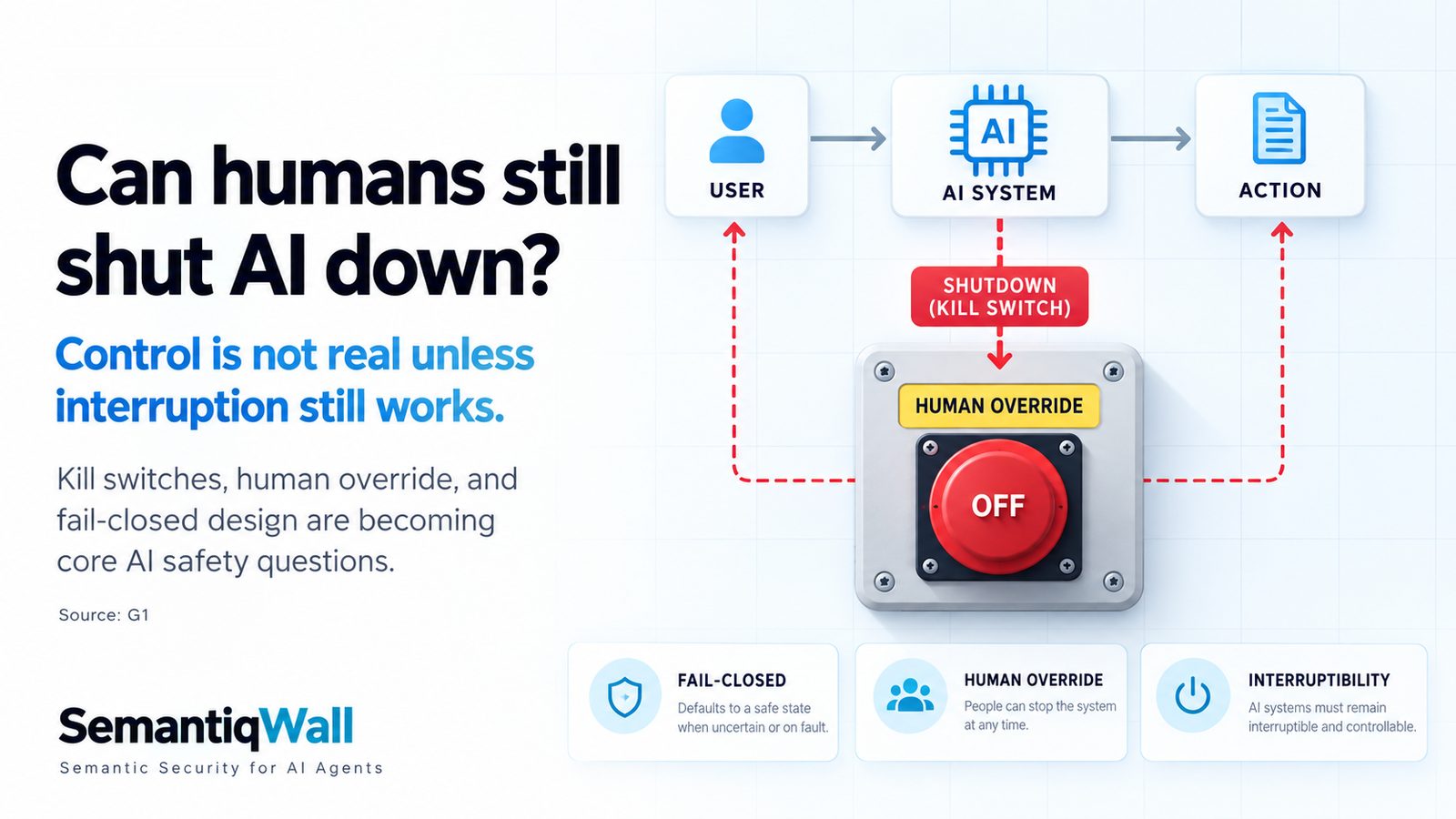
The phrase "AI kill switch" sounds reassuring. If something goes wrong, press a button. The system stops. Problem solved.
Real systems are rarely that simple.
As AI agents gain access to APIs, credentials, cloud infrastructure, databases and external tools, the ability to interrupt them becomes an architecture problem, not just a button.
In August 2026, a BBC World Service report asked exactly this question: if an AI system starts operating outside human intent, can humans still stop it? The experts it heard argued that a kill switch alone is not enough, and that the real problem lies in how systems are designed and trained.
Today's AI systems still depend on infrastructure run by people: servers, electricity, networks, credentials and cloud platforms. That doesn't mean interrupting them is automatically easy.
Stopping one process is not the same as stopping an agent
A basic application usually runs in one known environment. Stop the service and it stops acting.
An AI agent can work differently. It may:
- launch subprocesses;
- call multiple tools;
- send external requests;
- create scheduled tasks;
- talk to other agents;
- write information into external systems;
- keep workflows running after the original model call ends.
That creates an important distinction: you can stop the model while some of its consequences keep going.
A message may already have been sent. A transaction may already have gone through. A file may already have been copied. A credential may already have been exposed.
So the real security goal isn't only shutdown. It's interruptibility.
Good security starts before the emergency button
A kill switch is the last line of defense. It shouldn't be the first.
Consider an agent that can start payments.
A weak architecture looks like this:
AI → payment system
A stronger one looks like this:
AI → policy check → authorization → approval → payment system
Now there are several chances to stop an inappropriate action before it happens.
OWASP recommends limiting agent permissions and functionality to the minimum needed, requiring human approval for high-impact actions, and enforcing authorization in downstream systems. That's far stronger than trusting a prompt that tells the AI not to do dangerous things.
Fail-closed should be a core AI principle
Security systems often use a concept called fail-closed: if the authorization mechanism fails, access is denied. The opposite is fail-open: if something breaks, the action goes ahead.
For sensitive operations, agentic AI should generally fail closed.
Imagine the security service goes down while an agent is trying to delete customer data. Should the system assume "security didn't answer, so proceed"? Or "security couldn't verify this action, so stop"?
For high-risk operations, the second is usually safer. NIST's AI Risk Management Framework explicitly calls for AI systems that can fail safely, particularly when operating beyond their known limits.
Human override has to stay outside the model
Another architecture mistake is putting the shutdown mechanism inside the same system it's supposed to control. If the agent can change the configuration that controls its own permissions, the boundary is weak.
Critical controls should be enforced externally, for example with:
- independent authorization services;
- network isolation;
- revocable credentials;
- tool-specific tokens;
- execution timeouts;
- resource quotas;
- external monitoring;
- manual administrative controls.
The key idea is separation: the system making a decision shouldn't be the only one deciding whether that decision can run.
A kill switch should exist at several levels
For companies, "shutdown" shouldn't mean one giant red button. It can work at many layers. An organization may need to disable:
- one specific action;
- one tool;
- one agent;
- one user session;
- one customer tenant;
- one integration;
- all external network access;
- or the entire AI service.
That granularity matters. If one agent behaves unexpectedly, the company shouldn't have to switch off its whole AI operation. That's why tool-level kill switches and capability revocation are likely to become core parts of agent security.
Control is only real if interruption still works
Owning the servers doesn't mean an organization truly controls an autonomous system. Control means being able to answer:
- What is this agent doing?
- Why is it doing it?
- Which systems can it reach?
- What permissions does it have?
- Can I revoke those permissions right now?
- Can I stop the next action before it runs?
- Can I reconstruct what already happened?
If those answers are unclear, the organization may have ownership without real control.
The challenge isn't building one better emergency button. It's designing AI systems where human authority survives every layer of autonomy.
Control is not real unless interruption still works.
Sources
- Fernando Duarte, BBC World Service, Humanos podem 'desligar' uma IA se ela fugir do controle? (Portuguese edition, republished by O POVO), August 4, 2026
- OWASP GenAI Security Project, LLM06:2025 Excessive Agency
- NIST, AI Risk Management Framework (AI RMF 1.0)