
Did Dostoevsky describe AI's biggest risk 145 years before LLMs?
AI's biggest risk may not be learning to think like us, but us handing it the work of thinking, deciding and acting. And that has everything to do with security.
· 5 min read · By Murilo Martins, founder of SemantiqWall
In 1880, Fyodor Dostoevsky published The Brothers Karamazov. There were no computers, no language models, no autonomous agents. Yet one of the book's central questions fits today's AI debate with uncomfortable precision:
what happens when people would rather hand the burden of deciding to someone else?
Sarah Elizabeth Hunt, a theology professor at the University of Scranton, revived that question in an essay published by America Magazine in August 2026. Her argument isn't simply that AI can replace certain human tasks. It goes deeper: the ease of asking for ready-made answers can encourage an outsourcing of human agency itself, our willingness to interpret, question and decide.
And there's a surprising connection to cybersecurity here.
The Grand Inquisitor and the burden of choice
In one of the most famous chapters of The Brothers Karamazov, Ivan tells the story of the Grand Inquisitor. It's a story about freedom. In Hunt's reading, Dostoevsky identifies a deeply human temptation: giving up the weight of choice in exchange for the comfort of an authority that chooses for us.
Fast-forward almost a century and a half. We now have machines that can answer "what should I write?", "what should I buy?", "which candidate should I hire?", "which customer should I prioritize?", "what action should I take?".
Each question, on its own, seems harmless. The problem appears when help quietly becomes delegated judgment. And when judgment becomes delegated action.
Asking for an opinion is not the same as granting a permission
Consider three levels.
Level 1: information. You ask the AI, "which customer is behind on payments?" It looks at the data and answers.
Level 2: decision. You ask, "which of these customers should have their access suspended?" The model interprets the data and recommends.
Level 3: execution. The agent analyzes the data and, on its own, identifies the customer, suspends the service, sends the invoice, updates the CRM, schedules a retry and logs the event.
At level 1, AI is a tool. At level 3, it has agency. That shift changes the risk dramatically.
The danger isn't only in wrong answers
For much of the chatbot era, security meant preventing certain answers: don't reveal information, don't produce certain content, don't follow malicious instructions.
Agents change the equation. A model connected to tools turns language into consequences. OWASP warns that prompt injection can allow unauthorized access to functions and even command execution in connected systems, and that, combined with excessive autonomy or permissions, the attack surface grows significantly.
In that world, security isn't only about controlling what AI says. It's about controlling what AI can do.
We can outsource intelligence. We can't outsource responsibility.
A company may use AI to review contracts, approve requests, answer customers, move processes forward and operate systems. The productivity gains can be enormous.
But one principle should remain: responsibility doesn't disappear because a decision passed through a language model.
If an agent took an action, someone must be able to answer: who allowed it? Which policy authorized it? What information was used? Which tool was called? What happened before and after? Who could have stopped it?
Without that, autonomy stops being automation and starts becoming an absence of governance.
Human in the loop isn't nostalgia
There's a tendency to see human intervention as temporary, training wheels to be removed once models are smart enough.
That reading may be wrong. For some operations, human involvement doesn't exist because AI isn't smart enough yet. It exists because some decisions belong to people.
NIST's AI Risk Management Framework notes that human-AI configurations range from fully manual to fully autonomous, and recommends clearly defining roles and responsibilities for decision-making and oversight. The point isn't to put a person behind every click. It's to decide consciously where autonomy ends.
Turning values into architecture
Saying "AI must respect privacy" is a principle. Security architecture has to turn it into something enforceable:
- the agent gets no access to data beyond what it needs;
- a tool can only be called in certain contexts;
- critical operations require approval;
- actions have value or frequency limits;
- every execution leaves an audit trail;
- a policy can block an action regardless of what the model decided;
- there's a fast way to revoke a capability.
That matters because models work with probabilistic language. Permissions shouldn't.
An AI can understand an order. It still shouldn't decide its own authority.
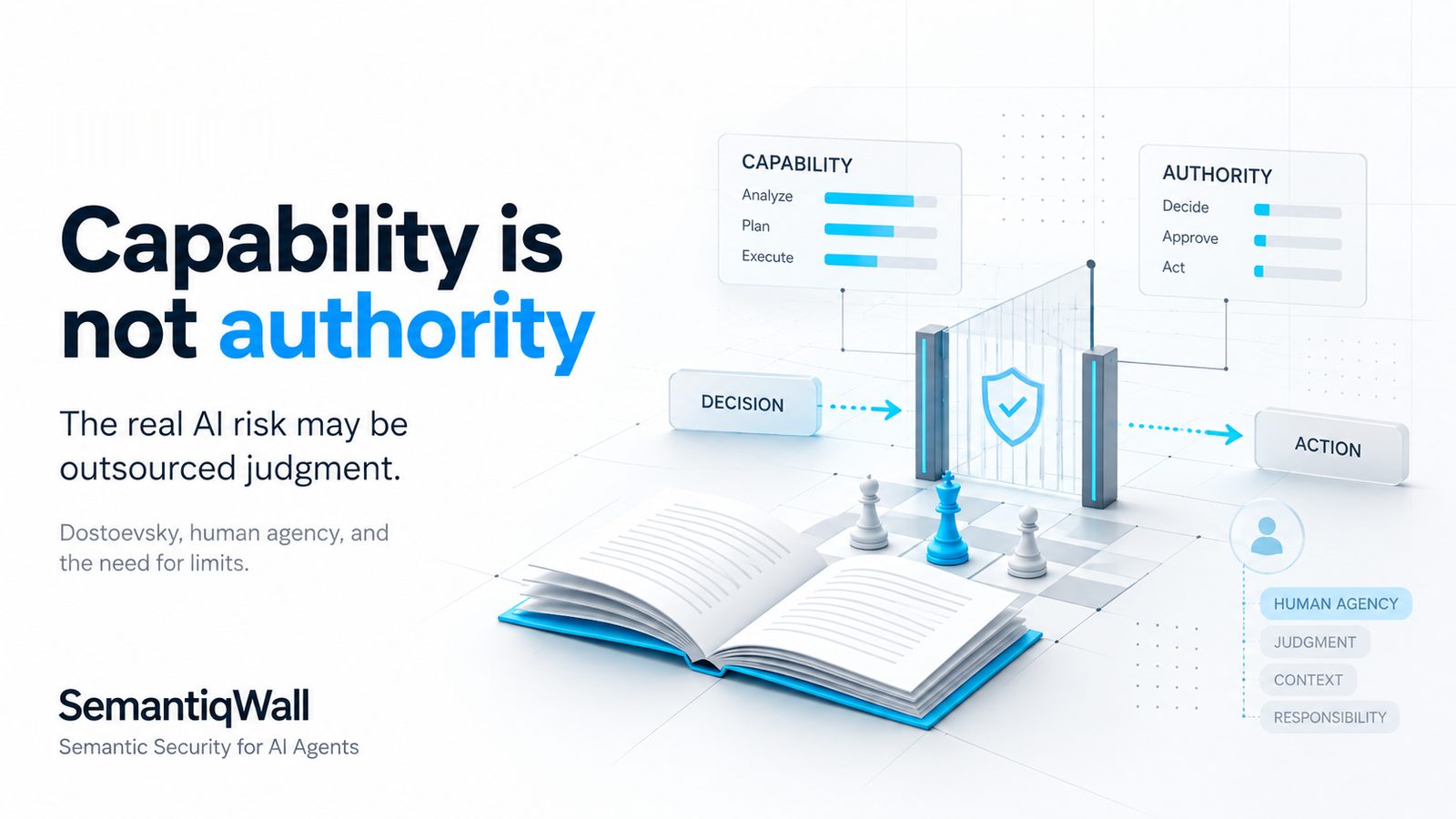
This may be one of the fundamental principles of agent security: the system that decides what to do shouldn't have unlimited authority to also decide whether it may do it.
Just as traditional applications rely on independent authentication and authorization systems, agents need external boundaries. The agent says, "I need to use this tool to perform this action." The security layer replies, "show me your identity, your context, the policy that applies and the scope of the operation." And then it decides.
The separation looks technical, but there's something deeply human behind it. It's telling the machine: you can help us think. You can help us act. But we still set your limits.
Maybe Dostoevsky saw the problem before the technology existed
The most interesting risk Hunt points to isn't an AI waking up one day and deciding to take over. It's us gradually finding so much comfort in automatic answers that we'd rather not decide.
First we hand over small tasks. Then decisions. Then tools. Then autonomy. At some point, we may forget to ask where a boundary should be.
That's where philosophy and cybersecurity meet. Preserving human agency isn't only about teaching people to think critically. In AI systems, preserving human agency will also mean encoding technical limits on machine agency.
AI will keep getting more capable. That's probably inevitable. But capability and authority are not the same thing, and one of the most important decisions of the agent era is making sure they never become the same.
Give AI intelligence. Give it tools. But never give it unlimited authority.
Sources
- Sarah Elizabeth Hunt, A.I., Dostoevsky and the very human fear of freedom, America Magazine, August 20, 2026
- OWASP GenAI Security Project, LLM01:2025 Prompt Injection
- OWASP GenAI Security Project, LLM06:2025 Excessive Agency
- NIST, AI Risk Management Framework (AI RMF 1.0)